China and Russia military ties
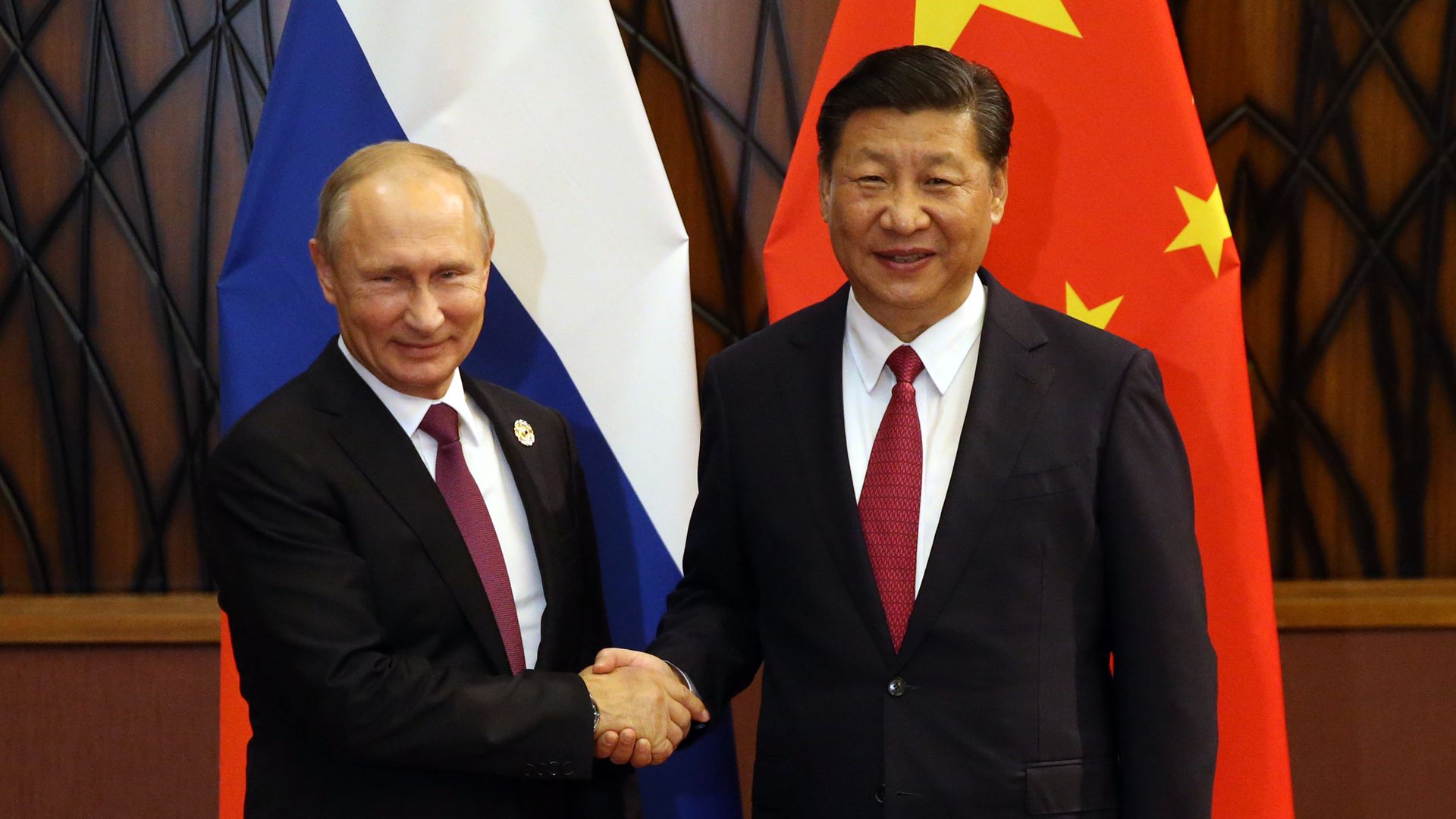
Russia, a candidate for future superpower might flatter China
China and Russia are allied against the Europeans and Americans still they are regional competitors. Chinese progression might be able to neutralise US impact but could prove to be more drastic to Russia as well. Both countries have certain issues regarding influence over former Soviet states and in the Arctic region. Would Russia allow Chinese dominance forgetting its own global motives and aspirations? Russia is itself a candidate for future superpower how could it allow someone else so easily.
The Sino-Soviet split in 1961 as a result of competition for controlling the worldwide communist movements brought tense relations between both. These tensions were lessened after the death of Mao Zedong in 1976. However, these relations dramatically improved after the disintegration of USSR in 1991. Russian President Boris Yeltsin had his first official visit to China in 1992. Since then both nations have been enjoying cordial relations in terms of defence, diplomacy and economy.
China has been a large importer of Russian military grade weapons since 1989 while it had to face certain trade restrictions by the European Union as a result of Tiananmen Square protests. Russia and China signed a five-year defence deal to promote and enhance their military capabilities in 1993. A year after they signed another agreement regarding the security of borders. This treaty was meant to control the air space violations and unintentional radar jamming. Both countries signed an agreement of good-Neighbourliness and Friendly cooperation in 2001.
In 1999 China made another agreement to purchase military aircrafts worth 1 billion jointly produced by Russia and Israel. This deal was signed by Ehud Barak, the then prime minister of Israel. Afterwards sale of Aircraft was blocked due to certain licensing issues in 2004. Currently, China is enhancing its military capabilities by manufacturing weapons domestically but still, it is largely dependent on Russia for jet engines and other weaponry. China is focusing on the production of submarines, warships and aircraft to build a competitive position in the Asia-Pacific region. Chinese are trying to become independent in their defence industry by outing a heavy investment in arms manufacturing. These initiatives are meant to secure strategic trade routes.
Apparently, Sino-Russia military relations are at zenith for the last few years but one needs a scalpel instead of a chain saw to infer the reality. China has always cautious in terms of Russian ambitions in the Arctic region. Chinese political and military leadership clearly announced their Arctic policy in 2018 that they would proactively interfere in Arctic affairs. Moreover, both nations have planned to hold joint military exercises named “Tsenter” this year. Strategic relations are in fact based on mutual interest rather sentiments. The meetings between the China-Russia leadership in the past five years have further fortified the military relations between both nations. Numerous bilateral agreements were signed by the two giants in the context of military and economic progress. The meetings between Chinese president Xi and Russian counterpart Putin held in 2013, 2015, 2017 and 2018 are considered to be detrimental to US interests.
Recently in 2018, both countries participated in Vostok war games held in Russia. About 300000 Russian troops including 36000 Chinese troops participated in it. Such exercises would enhance Chinese foreign experience by enabling their Generals to improve their strength outside their borders. These five-day drills are viewed as a symbolic display of weapons and command structure. Washington views these initiatives as a preparation for some futuristic goals which are certainly against the US interests. ‘’Vasili Kashin’’ an expert on Russia-China relations said that China wants to build an internationally capable fighting force. He viewed that China is following more assertive Russian behaviour flaunting its multi-billion dollars military modernization. These exercises will allow Chinese to minutely view how Russia plans for large scale conflicts and also how they manage logistical supplies.
On August 30, 2018, during a press conference, Chinese defence ministry spokesman Colonel Wu Qian displayed a map in showing 3200 Chinese troops, 900 pieces of weaponry and 30 fixed-wing aircrafts joining the drill which were being transported across the Russian border by rail, road and air. Russia and China have previously participated in many joint military programmes and exercises but this time Russia has invited Chinese to take part in Russia’s annual strategic exercise that provides training regarding the large-scale conflict.
Another analyst, Mr Clint Reach, who focuses on Russia and China military issues, said that these drills will provide an opportunity to Chinese for preparation of large-scale wars. He added that the focus is on the Pacific theatre for contingencies, in North Korea, for example. But the tested abilities could be applied in case of conflict with the West.
The Chinese troops participating in the joint exercises belong to PLA people’s Liberation Army Northern command which is responsible for North Korean contingencies. It is one of the regional commands which were established in 2016 after Xi the president of China announced reforms regarding the preparation of better Chinese military force which can handle external aggressions and treats. Training exercises last year brought Chinese and Russian air defence network together in which they distributed targets and destroyed them in real time.
Another factor behind the fortification of military ties between China and Russia is their fraying relations with the USA. Following U.S sanctions on Russia on occasion of Crimean war, Russia was pushed further from western political and economic cooperation, the Kremlin warned it would pivot east to boost ties with China. Relations of China with the USA also has the same fate in recent years due to Beijing’s efforts regarding territorial claims in Asia, including the construction of seven fortified islands in the disputed South China Sea.
Recently China and Russia made agreements of worth more than $100 billion. A group composed of Russian and Chinese business is ready to invest in 73 joint projects. These projects also include military-linked investments. Both countries are trying to counter the US sanctions—penalties. Beijing and Moscow have had a rocky relationship, but the two nations have publically sought closer ties in recent years.
Undoubtedly it can be said that the global imperatives brought China and Russia together otherwise there is a conflict of interest between the two countries on numerous strategic issues. Mr Jonathan Hillman, who is director of reconnecting Asia project at the centre for strategic and international studies in Washington DC, said that the Sino-Russia ties artificial in nature supported more by leader-on-high than organic developments on the ground. He added that after each ceremonial sittings and partnership promises, China still towers above Russia in economic and demographic terms. With a long history of invasions, Russia’s paranoia about foreign powers approaching its borders cannot disappear overnight. Mr Hillman also viewed that Russian policymakers must be persuaded to take China’s economic power as seriously as the West’s military power. China’s grand ambitions run through Russia and its neighbours, but its investments have not yet triggered alarms in Moscow. Russia is the gatekeeper for China’s overland push westward, but Xi now holds the keys in the form of investment and respect from the west, craves.
References:
https//:Axios.com
http//:europarl.europa.eu
http//:cnbc.com
http//:en.wikipedia.org
http//:thediplomat.com
http//:carnegieendowment.org
http//washingtonpost.com
http//:news.com.an
 FAKHAR BLOGS
Very professional and competent writer..
LikeLike
Thanks
LikeLike